
Porcelain countertops are made from kaolin clay, feldspar, and silica, fired at extreme heat into a dense, non-porous slab. The result looks like stone but behaves more like high-tech ceramic. If you have already narrowed your search to porcelain, here is a straight porcelain countertops pros and cons breakdown to help you commit.
The Pros
The case for porcelain is strong. In a few areas, it is best in class.
- Never needs sealing: porcelain is non-porous, so it never requires sealing. There is no annual upkeep and no window where the surface sits vulnerable.
- Highly heat resistant: it is fired far hotter than any stovetop. A hot pan can come straight off the burner without scorching or discoloring it.
- UV stable for outdoors: it will not fade or yellow in direct sun. That makes it one of the few surfaces suited to covered outdoor kitchens.
- Scratch and stain resistant: at around 7 on the Mohs scale, it shrugs off knives and cookware. Nothing soaks into its non-porous surface, either.
- A huge range of looks: advanced printing lets porcelain mimic marble, concrete, and wood. The pattern stays consistent from slab to slab, which natural stone cannot promise.
- Lightweight: it is thinner and lighter than natural stone. That can simplify installation and, in some cases, allow it to go over an existing surface.
The Cons
No material is perfect, and porcelain's limits are real. Here is the honest other side.
- Edges can chip: porcelain is hard but brittle. A sharp impact at an edge or corner can chip it, and the repair is difficult to hide.
- The pattern is usually surface-level: on most porcelain, the color and veining are printed on top rather than running through the slab. Fabricators use mitered edges to visually solve this.
- It needs a specialized fabricator: cutting and finishing porcelain takes diamond tooling and real experience. Not every countertop shop can do it well.
- Limited edge profiles: because the slab is thin, ornate edge profiles are not an option the way they are with thick natural stone.
- Higher cost than some options: porcelain often costs more than entry-level quartz or laminate, especially once the specialized fabrication is factored in.
Who Porcelain Is Right For
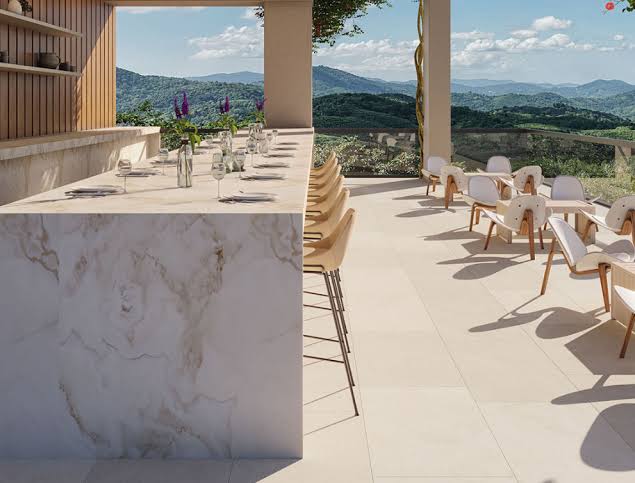
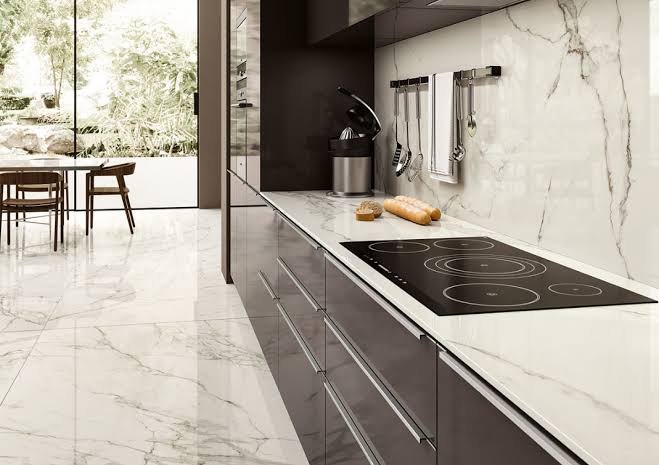
Porcelain is a great fit for busy kitchens, outdoor spaces, and anyone who wants a genuinely low-maintenance surface. If you cook constantly, hate upkeep, or want one material to run from an indoor island out to the patio, it is hard to beat. For porcelain kitchen countertops in a high-traffic household, that toughness is the whole appeal. It also suits clean, modern designs where a slim profile and a seamless look are the goal.
Who Might Look Elsewhere
Porcelain is not for everyone. If you want a thick, dramatic edge profile, natural stone or a built-up quartz edge will serve you better. If you are on a tighter budget, a quality quartz or granite may deliver more for less. And if the one-of-a-kind depth of real stone matters to you, engineered porcelain can feel a little flat up close.
The Part That Matters Most: Fabrication
One honest note before you decide. Porcelain is only as good as the person who fabricates it. Because it demands specialized tools and expertise, the installer matters as much as the slab. A skilled, porcelain-experienced fabricator is the difference between a flawless result and a chipped, misaligned one. Choose your fabricator as carefully as you choose the material.
See Porcelain in Person at Opustone
The best way to judge porcelain is to stand in front of it. Opustone carries quality porcelain lines like Relativa, so you can compare colors, finishes, and thicknesses up close. Better yet, you can weigh porcelain against quartz, granite, and quartzite side by side, all in one place. Book an appointment at our Miami, Fort Lauderdale, or West Palm Beach showroom, and our team will help you decide with your own eyes.
Frequently Asked Questions
For busy kitchens, outdoor spaces, and low-maintenance living, yes. Porcelain is one of the toughest, easiest-to-own surfaces available. It is less compelling if you want a thick edge profile or the absolute lowest price.
The surface is very hard, but edges and corners can chip under a sharp impact. A simple edge profile and a skilled fabricator reduce the risk significantly.
No. Porcelain is non-porous, so it never needs sealing. That is one of its biggest advantages over natural stone.